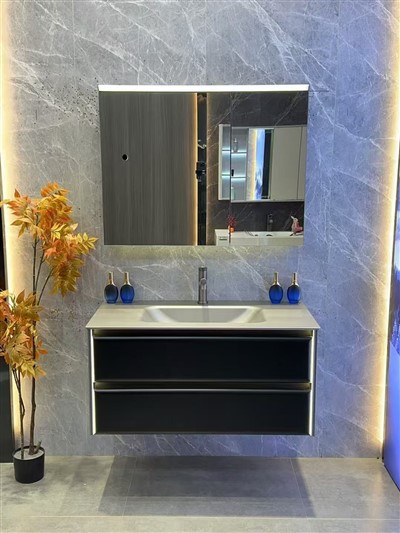


1. Ceramics
Bathroom countertops made of ceramic are the most common. Generally speaking, the basin of this kind of bathroom cabinet is also made of ceramic, and the countertop and basin are integrated. Ceramics are a material whose quality and performance mainly depend on its glaze and firing process.
Ceramic countertops and basins are cost-effective, have high hardness, are wear-resistant, scratch-resistant, anti-seepage and stain-proof, waterproof and moisture-proof, and are easy to clean and care for. However, they are single in style and color, have poor impact resistance, and have a cold texture. Moreover, inferior ceramics may have problems such as leakage, poor resistance to stains, easy breakage, yellowing and discoloration, etc.
2. Artificial stone
Artificial stone countertops, as the name suggests, are countertops made of artificial stone, such as artificial quartz stone and artificial marble. The main ingredients of artificial stone are stone powder, resin and other elemental substances. Artificial stone has many advantages. It has the texture and texture of natural stone, is stain-proof and anti-seepage, is wear-resistant and scratch-resistant, is easy to clean and maintain, and is cost-effective.
However, artificial stone is not resistant to high temperatures, has poor resistance to deformation, and is not as hard as natural stone. After being used for a long time, there is still the problem of color and staining. Moreover, artificial stone is not very environmentally friendly, especially low-quality artificial stone.
3. Natural stone
Natural stones, such as marble and granite, have natural textures, high appearance, and high-end atmosphere, which are conducive to creating a luxurious style. Use natural stone as the bathroom countertop, which has high hardness, wear resistance, scratch resistance, fire resistance, high temperature resistance, water resistance, moisture resistance, acid and alkali resistance.
However, natural stone is heavy and is used as a bathroom countertop, which puts a greater load-bearing test on the bathroom cabinet. Moreover, natural stone is not dense and has poor anti-seepage capabilities. It may cause color and water seepage after being used for a long time. It is inconvenient to clean and take care of, and it requires maintenance after being used for a long time.
4. Microcrystalline stone
Microcrystalline stone countertops were also very popular in the past. The material of microcrystalline stone is actually like a combination of ceramic and glass-ceramic. Microcrystalline stone has high appearance and delicate texture. It also has the advantages of anti-seepage, anti-fouling, waterproof and moisture-proof, etc. . However, the hardness of microcrystalline stone countertops is not high, and its wear and scratch resistance is poor. It is easy to leave scratches and affect the aesthetics.
5. Rock slab
Slate, since the birth of this material, has been enthusiastically sought after by consumers. There are many advantages of slate. Slate has high appearance, various styles, rich texture, and warm and delicate texture; slate has high hardness, is wear-resistant and scratch-resistant, and is impact-resistant and deformation-resistant; slate is acid and alkali resistant, anti-seepage and anti-fouling, and is easy to use. Clean and manageable, fireproof and waterproof; slate slabs are highly processable and can be widely used in various occasions and spaces.
There are slate bathroom cabinets on the market that have slate countertops and basins integrated into them, and there are also slate slabs and basins separated from each other. Compared with countertops made of other materials, slate countertops have better performance, but they are also more expensive. Some.