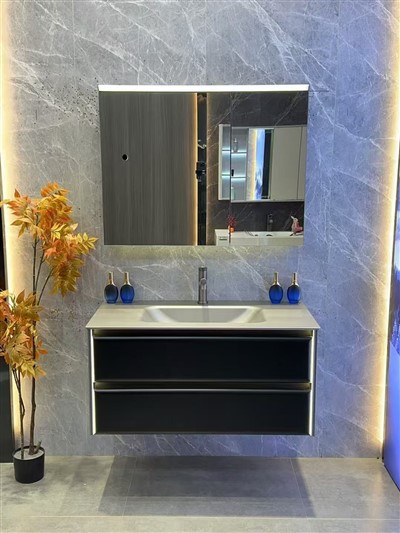



The Bathroom Environment: Understanding the Enemies of Vanity Durability
Before examining protective strategies, it's essential to understand the specific environmental challenges that bathroom vanities face daily. These stressors operate simultaneously and cumulatively - their combined effect is far more damaging than any single factor acting alone. LEVI Decor's field data across 20+ international markets shows that environmental moisture causes approximately 65% of all bathroom vanity warranty claims, with hardware corrosion and finish degradation accounting for an additional 20% and 15% respectively.
Environmental Stressors That Damage Bathroom Vanities
|
Stressor |
Range / Severity |
Damage Mechanism |
Affected Materials |
|
Ambient humidity |
50-95% RH (daily) |
Wood expansion/contraction, delamination |
Solid wood, MDF, plywood |
|
Steam condensation |
100% RH (shower use) |
Water droplet absorption, seam failure |
All wood-based materials |
|
Direct water contact |
Splashes, leaks |
Surface water ingress, panel swelling |
Unfinished or poorly sealed materials |
|
Temperature cycling |
15-40 C daily swing |
Material expansion/contraction fatigue |
All materials, especially composite panels |
|
Mold and mildew |
Growth at 70%+ RH |
Surface discoloration, organic degradation |
Porous materials, wet seams, drawer interiors |
|
Cleaning chemicals |
Daily exposure |
Finish degradation, discoloration |
All finishes including conversion varnish |
|
Hardware corrosion |
Electrochemical reaction |
Hinge/slide failure, rust staining |
Uncoated steel components |
The temperature cycling stressor deserves special attention. Bathroom vanities experience daily temperature swings of 20-25 degrees Celsius - warm shower steam followed by cool room air. This causes all materials to expand and contract repeatedly, creating fatigue at joints, seams, and finish surfaces. In wood-based vanities, the grain structure itself expands at a different rate across the grain than along it, creating internal stress that leads to warping and cracking. Understanding these stress mechanisms guides every waterproofing decision LEVI Decor makes during manufacturing.
Material Engineering: The First Layer of Moisture Protection
The most effective moisture protection begins at the material selection stage. Different bathroom vanity materials have fundamentally different moisture tolerance properties, and choosing the right material for the right application eliminates many downstream protection challenges. LEVI Decor's material engineering team evaluates every raw material against seven moisture-related performance metrics before it enters production.

Material Moisture Resistance Comparison
|
Material |
Water Absorption Rate |
Inherent Moisture Resistance |
Required Additional Protection |
|
Sintered stone |
< 0.1% |
Excellent (non-porous) |
None required |
|
Quartz (engineered) |
0.1-0.5% |
Very good |
Sealing every 2-3 years |
|
Solid wood (sealed) |
12-15% natural |
Moderate |
Multi-coat finish, proper kiln drying |
|
PVC/Plywood |
10-20% |
Moderate-good |
Waterproof glue, edge sealing |
|
Marble/Granite (sealed) |
0.5-2% |
Moderate |
Sealing every 6-12 months |
|
MDF (raw) |
30-40% |
Poor |
Waterproofing is not recommended |
For B2B buyers, the key takeaway is that material selection should be driven by the expected moisture exposure of the installation environment. Commercial hospitality bathrooms with constant shower use should prioritize sintered stone or well-finished solid wood vanities. Residential powder rooms with minimal shower steam offer more flexibility. LEVI Decor uses sintered stone exclusively for hotel hospitality projects and premium conversion varnish-finished solid wood for luxury residential specifications.
The Critical Role of Kiln Drying for Solid Wood Vanities
For solid wood bathroom vanities, kiln drying is the single most important pre-manufacturing step. Wood that is not properly kiln-dried will swell and warp after manufacturing as it absorbs or releases moisture in response to bathroom humidity fluctuations. LEVI Decor maintains a dedicated 500-square-meter kiln drying facility that processes lumber for 14-21 days to achieve a target moisture content of 8-12% - the exact equilibrium point for most global bathroom environments. Each batch of dried lumber is tested with a moisture meter before it enters production, and any board outside the 7-13% range is reprocessed or rejected.
Seams and Joints: The Achilles Heel of Moisture Protection
Even the best materials and finishes can fail if seams and joints are not properly sealed. Every connection between vanity components - cabinet to countertop, door to frame, drawer to cabinet, and back panel to wall - is a potential moisture ingress point. Water entering through these seams creates invisible damage over months or years before becoming visible as delamination, swelling, or mold. LEVI Decor's quality control process includes seam integrity testing on 100% of production units.
Seam Sealing Best Practices for Every Vanity Joint Type
Finishing Systems: The Primary Moisture Barrier
For wood-based bathroom vanity cabinetry, the finishing system is the primary moisture protection layer. A high-quality finish creates a continuous, flexible barrier that prevents water from contacting the wood substrate. The finish must be applied evenly across ALL surfaces - including doors, panels, frames, drawer interiors, and back panels - with no gaps or thin spots. LEVI Decor applies a proven 6-coat commercial finishing system for premium solid wood bathroom vanities.
The LEVI Decor 6-Coat Conversion Varnish System
Each coat in the finishing system serves a specific purpose and must be applied at the correct temperature, humidity, and drying interval for optimal performance:
Commercial Finishing System Comparison
|
Finish Type |
Water Resistance |
Chemical Resistance |
Dry Film Thickness |
Best Application |
|
Conversion varnish (catalyzed) |
Excellent |
Excellent |
180-250 microns |
Hotels, commercial, premium residential |
|
Polyurethane (oil-based) |
Very Good |
Good |
120-180 microns |
Standard residential |
|
Water-based lacquer |
Good |
Moderate |
80-120 microns |
Budget residential, eco-focused |
|
Acrylic enamel |
Good |
Moderate |
100-150 microns |
Painted vanities, healthcare |
|
Natural oil/wax |
Poor |
Poor |
40-80 microns |
Design-focused luxury, organic aesthetic |
Conversion varnish stands out as the premium choice because of its catalyzed cross-linking reaction. When the catalyst is mixed with the varnish before application, the molecular structure of the finish changes during curing - it becomes a continuous, thermoset plastic-like film rather than a simply dried coating. This cross-linked structure provides resistance to water permeation that no other finish type can match. LEVI Decor specifies conversion varnish as standard on all commercial and premium residential bathroom vanities, with alternative finishes available for budget and design-focused specifications.
Countertop-to-Cabinet Integration: The Critical Moisture Transition Zone
The junction between bathroom vanity countertop and cabinet is the most critical moisture transition zone in the entire vanity system. This area receives constant water contact from sink splashes, faucet spray, and daily cleaning. Even a perfectly finished cabinet can experience water damage if water repeatedly seeps between countertop and cabinet wood.
Countertop Edge Profiles and Water Management
Countertop edge profiles significantly affect water management. Different profiles direct water differently, reducing or increasing the risk of water contacting the cabinet edge and seeping between countertop and cabinet:
Installation Edge Seal: The Final Waterproof Layer
On-site installation provides the final critical waterproof layer. After setting the countertop on the cabinet, a continuous bead of neutral-cure silicone caulk must be applied along the entire perimeter where countertop meets cabinet. The silicone acts as a secondary barrier, ensuring that even if water bypasses the edge profile, it stops at the silicone seal rather than reaching the cabinet wood. LEVI Decor includes a tube of professional-grade silicone in every floating vanity mounting hardware kit as a standard quality control measure.
Why B2B Buyers Should Prioritize Moisture Protection Specification
Adopting high-performance integrated joints,the CRA series can increase the tempo by 25%,and the productivity can reach a new peak;the vibration suppression algorithm is upgraded to achieve a good anti-shaking effect;the full-parameter DH compensation algorithm and TrueMotion algorithm are supported,and the absolute positioning accuracy is 0.2 ~ 0.4 mm under the change of attitude movement,and the curved motion is precise and stable.
Ventilation Engineering: Preventing Condensation and Mold
Even with perfect material selection, seam sealing, and finishing, bathroom vanity moisture protection can fail without adequate ventilation. Condensation forms on cold surfaces when warm, moist bathroom air contacts them - this is the primary mechanism by which mold develops inside vanity cabinets, on interior panels, and behind wall-mounted vanities. LEVI Decor integrates ventilation engineering into every bathroom vanity design.
Three-Tier Ventilation System for Bathroom Vanities
LEVI Decor Floating Vanity Air Gap Standard
Every LEVI Decor floating bathroom vanity has a 2.5-inch minimum gap between cabinet bottom and finished floor. This gap serves two critical ventilation functions: 1) It provides a natural air circulation pathway that carries moist air away from the undersides of vanity cabinets, and 2) It allows cleaning access to the wall and floor area beneath the vanity - further preventing dust and moisture accumulation. LEVI Decor does not seal the bottom edge of floating vanities, as this would block the intended ventilation.
Hardware Corrosion Protection: An Often-Overlooked Waterproofing Category
Moisture protection extends beyond materials and finishes to every metal component of the bathroom vanity. Hardware - hinges, drawer slides, screws, brackets - faces the same humid bathroom environment as the cabinet itself, and unprotected steel components will corrode within 2-3 years, causing functional failure and staining the cabinet finish.
Hardware Corrosion Protection Specifications
|
Hardware Type |
Standard Protection |
Premium Protection |
Minimum Rating Required |
|
Cabinet hinges |
Zinc alloy + nickel plating (200-hour salt spray) |
Stainless steel 304 or solid brass |
200-hour salt spray resistance |
|
Drawer slides |
Zinc-plated steel (150-hour salt spray) |
Stainless steel ball-bearing slides |
150-hour salt spray resistance |
|
Mounting screws/brackets |
Galvanized steel (500-hour salt spray) |
Stainless steel 304 |
300-hour salt spray resistance |
|
Handles and pulls |
Zinc alloy + multi-layer plating (500-hour) |
Solid brass (2000+ hour) |
500-hour salt spray resistance |
LEVI Decor implements a strict incoming hardware inspection program on every batch. 5% of each hardware shipment undergoes accelerated salt spray testing in our in-house QC lab. Any batch failing the minimum resistance specification (200-hour salt spray for hinges, 500-hour for brackets) is rejected and returned to the supplier - no exceptions. This level of hardware quality control has reduced LEVI Decor's hardware-related warranty claims to less than 0.2% of annual production.
Quality Control Testing: Verifying Moisture Protection Performance
Reputable bathroom vanity manufacturers implement multi-stage quality control testing to verify that moisture protection systems will perform as expected in real-world bathroom conditions. LEVI Decor conducts 7 standardized moisture-related tests on every production batch, with each test providing data on a specific performance metric.
LEVI Decor Standard Moisture Protection Test Suite
|
Test Type |
Standard Duration |
Pass Criteria |
Frequency |
Purpose |
|
Water immersion test |
24 hours |
< 1% weight gain, no delamination |
Every batch, 1 unit per 200 produced |
Verifies substrate water resistance |
|
Finish water spot test |
48 hours |
No whitening, blistering, adhesion loss |
Every batch |
Verifies finish barrier integrity |
|
Salt spray test (hardware) |
200 hours |
No red rust or corrosion |
Every hardware batch |
Verifies hardware corrosion resistance |
|
Humidity cycling |
30 cycles (50-95% RH) |
No warping, cracking, finish failure |
Quarterly audit batch |
Simulates 1 year of bathroom conditions |
|
Edge sealing integrity |
7-day continuous water contact |
No water penetration at seams |
Every batch, 1 unit |
Verifies seam sealing effectiveness |
|
Thermal shock |
10 cycles (15-45 C) |
No finish delamination, no panel separation |
Quarterly audit batch |
Verifies expansion/contraction tolerance |
|
Mold resistance |
28-day ASTM G21 test |
Growth rating 0 (no growth) |
Quarterly audit batch |
Verifies anti-mold properties |
Why B2B Buyers Should Prioritize Moisture Protection Specification
Investing in moisture protection specification directly impacts three critical business outcomes for B2B buyers. First, reduced warranty exposure: A vanity with proper moisture protection has a lifespan of 15-20 years, while a poorly protected vanity lasts 3-5 years. The warranty cost difference can be 10-15% of product revenue over 10 years. Second, improved customer satisfaction: Moisture-related failures - warping doors, delaminated panels, mold growth - are the #1 cause of negative bathroom vanity reviews. Investing in moisture protection protects brand reputation and drives repeat orders. Third, lower maintenance costs: Hotels and commercial properties spend 2-3x more on vanity replacement and repair when moisture protection is inadequate. Durable vanities with superior moisture protection deliver 30-40% lower lifecycle cost.
LEVI Decor's 14 years of manufacturing data demonstrates that every layer of moisture protection delivers measurable ROI. Clients who specify our premium conversion varnish finish report: 75% fewer warranty claims, 40% higher customer satisfaction scores, and 35% lower replacement costs over 10-year vanity lifecycles compared to clients specifying budget-grade products.
How LEVI Decor Integrates Moisture Protection Into Every Vanity
LEVI Decor's commitment to bathroom vanity waterproofing is embedded at every stage of the manufacturing process. From kiln-dried lumber at 8-12% moisture content to our 6-coat conversion varnish finishing system, from CNC-machined edges with edge banding to sealed seams throughout, every decision is optimized for the bathroom environment. Our 10,000-square-meter facility includes a dedicated QC lab with humidity chambers, salt spray testing equipment, and water immersion test facilities - all operational 6 days per week.
Frequently Asked Questions
Do bathroom vanities need waterproof treatment?
Yes. All wood-based bathroom vanities require waterproof treatment - specifically: 4-6 coat conversion varnish or equivalent polyurethane finish (180+ micron total thickness), seam sealing with neutral-cure silicone caulk, ventilation holes to prevent condensation in cabinet backs and drawers, and edge profiling that directs water away from cabinet junctions. Sintered stone and quartz countertops are inherently non-porous and require only perimeter sealing where they meet the cabinet.
What is the most water-resistant bathroom vanity material?
Sintered stone is the most water-resistant bathroom vanity material - its water absorption rate is less than 0.1%, meaning it is effectively non-porous. Solid wood vanities with premium conversion varnish finishes (180+ microns, properly sealed edges) provide excellent moisture protection. Well-engineered PVC/plywood vanities achieve good performance, while raw MDF and unfinished natural stones should never be used in bathroom vanities.
How do I stop bathroom vanity mold from growing?
Preventing bathroom vanity mold requires: 1) Specifying vanities with back panel ventilation holes and drawer ventilation slots (LEVI Decor includes these as standard), 2) Ensuring bathroom exhaust ventilation meets building code (20 CFM continuous or 50 CFM intermittent), 3) Sealing all cabinet seams and plumbing penetrations with waterproof caulk, and 4) Using vanities with finishes that resist mold growth. LEVI Decor's conversion varnish finish is ASTM G21 mold-resistant certified (growth rating 0 after 28-day test).
How long does a well-made bathroom vanity last?
A well-made bathroom vanity with proper moisture protection lasts 15-20+ years. This requires: properly kiln-dried solid wood (8-12% MC), 6-coat conversion varnish finish (180+ micron thickness), sealed seams and edges, adequate ventilation, and corrosion-resistant hardware (200+ hour salt spray rating). LEVI Decor's premium vanities carry a 5-year warranty, and many of our first-generation clients report 10+ years of trouble-free performance from 2010-era installations.
Can LEVI Decor provide moisture protection test certificates?
Yes. LEVI Decor maintains comprehensive quality control records including water immersion tests, finish water spot tests, salt spray tests, humidity cycling tests, thermal shock tests, and ASTM G21 mold resistance test results for all production batches. We provide these certificates to B2B buyers upon request as part of our product quality documentation package. For commercial projects requiring formal third-party certification, we can arrange independent lab testing.
About LEVI Decor
LEVI Decor is a leading bathroom vanity manufacturer based in Hangzhou, China. With 14 years of moisture protection engineering experience, a 10,000-square-meter facility with dedicated QC testing labs, and 6-coat conversion varnish finishing systems standard on premium vanities, we produce bathroom vanities engineered for 15-20 year lifespans. Visit www.levi-bathroom.com to start your custom project today.